Nail Fungus Under the Nail: Why It Hides and How to Reach It
The most common and most stubborn form of nail fungus does not sit on the surface of the nail where treatments can easily reach it. It lives in the nail bed beneath the nail plate, protected from the outside world, and requires a specific approach to address effectively.
Subungual fungus is the most common nail fungus type
Standard surface sprays cannot reach it reliably
Deep-penetrating delivery is the key differentiator in topical treatment
Early-stage infection is significantly easier to treat than advanced
The medical term for nail fungus that develops beneath the nail plate is distal subungual onychomycosis (DSO). It is the most prevalent form, accounting for the majority of nail fungus cases in adults.
🔍
How It Starts
DSO typically begins at the hyponychium, the junction between the free nail edge and the skin of the fingertip. Fungi enter through this gap and migrate proximally (toward the nail base), colonising the nail bed beneath the plate.
By the time the nail visibly changes colour or texture, the fungus has already established a significant colony beneath the nail.
🛡️
Why It Is So Protected
The nail plate acts as a physical barrier, shielding the nail bed from topical treatments applied to the surface. The plate is composed of tightly packed keratin layers that most water-based or alcohol-based formulas cannot penetrate reliably.
This is why treatments that only contact the nail surface achieve limited results against established subungual infections.
🎨
Visual Signs
Distal subungual onychomycosis typically presents as yellow, white, or brown discolouration starting at the nail tip, thickening of the nail plate, crumbling or brittle nail edges, and in advanced cases, separation of the nail from the nail bed (onycholysis).
📊
How Common Is It?
Onychomycosis affects an estimated 10% of the general population and up to 20% of adults over 60. DSO is the most common subtype. The prevalence increases significantly with age, reduced circulation, diabetes, and frequent exposure to moist environments.
Stages of Progression
How Subungual Fungus Progresses If Untreated
Understanding the stages helps set realistic expectations for treatment difficulty and timeline.
Stage 1: Early
Distal Tip Involvement
The fungus has entered through the nail tip junction and begun colonising the distal nail bed. The nail may show a small patch of white or yellow discolouration at the tip.
Most treatable stage. Topical treatments with good penetration have the best chance of success here.
Stage 2: Moderate
Proximal Spread
The fungus has migrated backward, now occupying the middle portion of the nail bed. The nail shows visible thickening, discolouration covering 30–60% of the plate, and may begin to crumble at the edges.
Topical treatment is still viable but requires more time and consistency. Deep-penetrating formulas are particularly important at this stage.
Stage 3: Severe
Full Nail Involvement
The fungus now occupies the majority of the nail bed. The entire nail appears thickened, discoloured, and may separate from the nail bed (onycholysis). The nail matrix (growth centre) may be affected.
Prescription oral antifungals are generally recommended at this stage. Topical-only treatment has limited evidence of success for full-nail involvement.
Treatment Options
What Can Actually Reach Fungus Under the Nail?
Treatment Type
Reaches Sub-Nail
Suitable For
Key Limitation
Deep-penetrating topical gel (DermaFix)
✓ Designed to
Stage 1–2
Active concentration undisclosed
Standard topical sprays/drops
✗ Surface only
Surface/skin only
Cannot reach nail bed reliably
Prescription ciclopirox lacquer
✓ Yes
Stage 1–3
Requires prescription, slow cure rates
Prescription oral antifungals (terbinafine)
✓ Systemic reach
Stage 2–3
Liver monitoring required
Laser treatment
~ Limited
Stage 1–2
Expensive, limited long-term evidence
Home remedies (vinegar, Vicks)
✗ Surface only
Mild surface involvement
Minimal evidence for sub-nail use
⚠️
The delivery problem: Many people try multiple topical products without success, not because topical treatment is ineffective in principle, but because the product they used had no mechanism to penetrate the nail plate. Whether a topical formula includes a dedicated penetration-enhancing carrier is the single most important technical factor to evaluate.
The DermaFix Approach
How DermaFix Targets Subungual Fungus
DermaFix addresses the sub-nail delivery challenge through a combination of Emu Oil and Squalane, two lipid-based compounds known for their ability to penetrate deeply into skin and nail tissue. These act as a carrier system, transporting the active antifungal ingredients (Tea Tree Oil and Colloidal Silver) beneath the nail surface.
🦅
Penetration Carrier
Emu Oil
Emu oil has an established history in cosmetic and therapeutic topical applications for its transdermal penetration capability. Its lipid composition closely resembles human skin lipids, which facilitates movement through the nail plate layers.
In DermaFix, it functions as the primary vehicle driving active ingredients toward the nail bed.
💧
Co-Carrier + Moisturiser
Squalane
Squalane is a lightweight, stable lipid that enhances skin permeability and improves the delivery of co-formulated actives. It also maintains hydration in the nail bed, supporting the tissue repair process as healthy nail grows in.
As a secondary delivery vehicle, it works alongside Emu Oil to maximise the chance of active ingredients reaching the infection site.
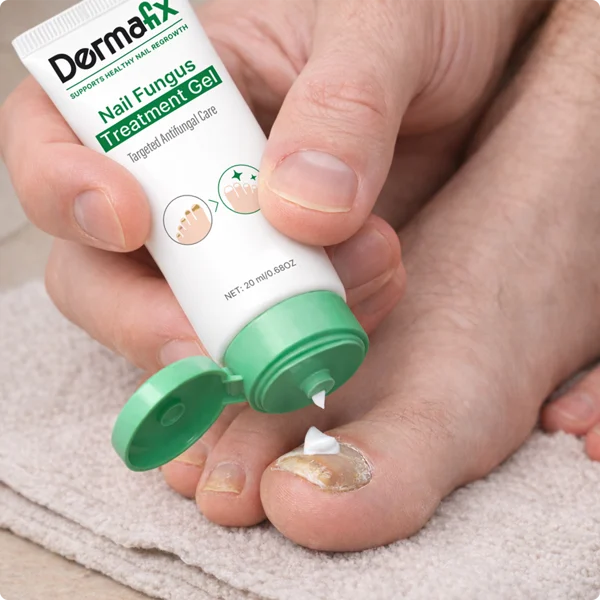
Application tip for under-nail fungus: When applying DermaFix, use the applicator tip to reach under the free edge of the nail where accessible, and press gently at the sides of the nail fold. After applying, massage the area for 30–60 seconds to encourage penetration through the nail plate layers.
Nail fungus beneath the nail plate is most commonly a type called distal subungual onychomycosis (DSO). It starts at the nail tip and migrates toward the nail base, colonising the nail bed. It is the most prevalent form of nail fungus in adults.
Standard water-based or alcohol-based topical products struggle to penetrate the nail plate. Oil-based formulas with dedicated penetration carriers, such as Emu Oil or dimethyl sulfoxide (DMSO), have a better theoretical basis for reaching subungual fungus. Prescription lacquers also include nail-penetrating components.
Gently thinning the nail with a nail file can reduce the physical barrier the nail plate presents to topical treatment. This is a commonly recommended adjunct step, particularly for thickened nails. Avoid aggressive filing, which can damage the nail fold and skin.
Prescription treatment is generally recommended when the infection has progressed to involve more than half the nail plate, when the nail matrix (growth area) appears affected, when the person has diabetes or immunosuppression, or when multiple rounds of topical OTC treatment have failed.
Yes. Fungal spores can be transferred from an infected nail to adjacent nails through shared footwear, socks, nail clippers, and communal surfaces. Treating all affected nails simultaneously and practising good nail hygiene reduces the risk of spread.
In advanced cases where onycholysis (nail separation) has occurred, the affected nail may partially or fully detach. New nail growth from an unaffected matrix will regrow, but the process can take 12 to 18 months. Medical evaluation is recommended in cases of significant nail separation.
Target the Fungus Where It Actually Lives
DermaFix is formulated to reach beneath the nail surface, addressing subungual fungus directly. Try it risk-free with a 90-day guarantee.
With over 15 years of experience studying natural health solutions, Dr. Rhodes specialises in evaluating naturally-derived topical and supplement formulas for real-world applicability and evidence-based merit.
Her role is educational, not promotional. Her opinions do not replace medical advice.
Medical Disclaimer
The information on this page is for educational purposes only and is not intended to diagnose, treat, cure, or prevent any disease. Always consult a qualified healthcare professional before starting any new treatment. Individual results vary.
DermaFix is a topical cosmetic gel and is not evaluated or approved by the FDA for treatment of any medical condition.
Affiliate Disclosure: This page contains affiliate links. We may earn a commission if you purchase through our links, at no extra cost to you.