Evidence Review — 2026

Tea Tree Oil for Nail Fungus: What the Research Actually Shows

Tea tree oil is one of the most widely discussed natural remedies for nail fungus. But how strong is the actual evidence, what concentration is needed, and is applying raw tea tree oil to your nails really the best approach? This guide covers the research and the practical realities.

  • Evidence reviewed from published clinical and lab studies
  • Concentration requirements explained clearly
  • Limitations of standalone tea tree oil applications
  • How DermaFix uses tea tree oil within a full delivery system
See DermaFix Tea Tree Formula →
Tea tree oil nail fungus treatment

Tea Tree Oil: Origins and Antifungal Properties

Tea tree oil (Melaleuca alternifolia oil) is an essential oil extracted by steam distillation from the leaves of the Melaleuca alternifolia tree, native to Australia. It has been used in traditional Aboriginal medicine for centuries and entered mainstream western wellness practice in the 20th century.

🌿

Active Compounds

The antifungal activity of tea tree oil is primarily attributed to terpinen-4-ol, the dominant constituent at 30–48% of the oil's composition. Other active monoterpenes contribute to its broad-spectrum antimicrobial profile.

🔬

How It Works

Terpinen-4-ol disrupts fungal cell membrane integrity, causing leakage of intracellular contents and inhibiting cellular respiration. This mechanism makes it effective against multiple fungal species, including Trichophyton rubrum, the most common cause of nail fungus.

🏳

Research Status

Lab evidence (in vitro) for tea tree oil's antifungal activity is well-established. Human clinical trial evidence is more limited, but studies have shown meaningful results for superficial nail fungus at adequate concentrations applied consistently over several months.

What Clinical Research Shows

The clinical research on tea tree oil for nail fungus is real but modest. Here is an honest summary of what the studies show and what they do not.

What Research Supports

A clinical study published in the Journal of Family Practice found that 100% tea tree oil was comparable to clotrimazole 1% solution for partial nail clearing after 6 months of daily application.

Multiple in vitro studies have confirmed activity against T. rubrum, T. mentagrophytes, and several Candida species at concentrations of 0.5% to 2%.

A study using a 5% tea tree oil nail solution found improvements in nail appearance and reduced fungal burden after 16 weeks in the majority of participants.

What Research Does Not Support

No large-scale randomised controlled trial has established tea tree oil as a clinically proven nail fungus treatment to the standard required by regulatory agencies.

Mycological cure rates (complete elimination of fungus confirmed by lab test) are significantly lower than those achieved by prescription oral antifungals.

Tea tree oil applied alone in a basic carrier has poor nail penetration, meaning surface application may not reach the subungual fungus where the infection is actually established.

⚠️

Important context: Most positive outcomes in tea tree oil studies involved superficial or early-stage infections. Advanced subungual onychomycosis (deep nail bed infection) consistently shows poor response rates with topical-only treatment, including tea tree oil, regardless of formulation.

The Concentration Question: How Much Is Enough?

ConcentrationResearch ContextPractical Notes
0.5%–2%Active in in vitro (lab) studies against common fungiBelow typical clinical use threshold for nail application
5%–10%Used in clinical nail solution studies; positive outcomes reportedAppropriate starting point for formulated topical products
25%Higher clinical studies; better penetration depth outcomes reportedMay cause mild skin irritation at nail edges in sensitive individuals
100% (undiluted)Comparable to clotrimazole in one study for partial clearingRisk of skin sensitisation and irritation; not recommended for regular long-term use

Why concentration disclosure matters: Most commercial tea tree oil products do not state their active concentration clearly. Without knowing what percentage is in a product, it is impossible to evaluate whether it falls within the range studied in clinical research. This is one of the transparency limitations shared by DermaFix and many natural topical products.

Why Applying Raw Tea Tree Oil Often Disappoints

Even if a tea tree oil product contains adequate concentration, there is a second challenge: getting it through the nail plate to the nail bed where the fungus lives. Raw tea tree oil in an alcohol or water base evaporates quickly and has limited capacity to penetrate the dense keratin layers of the nail plate.

💧

The Penetration Challenge

Tea tree oil is hydrophobic (water-repelling) and lipophilic (oil-soluble), which gives it some natural affinity for lipid-rich nail structures. However, without a dedicated carrier to drive it through the nail plate layers, much of the applied oil remains on the nail surface.

🔬

What Improves Penetration

Lipid-based carriers like Emu Oil and Squalane have established nail and skin permeation properties. When tea tree oil is suspended in these carriers, its ability to reach the nail bed is meaningfully improved compared to aqueous or standalone application.

How DermaFix Incorporates Tea Tree Oil

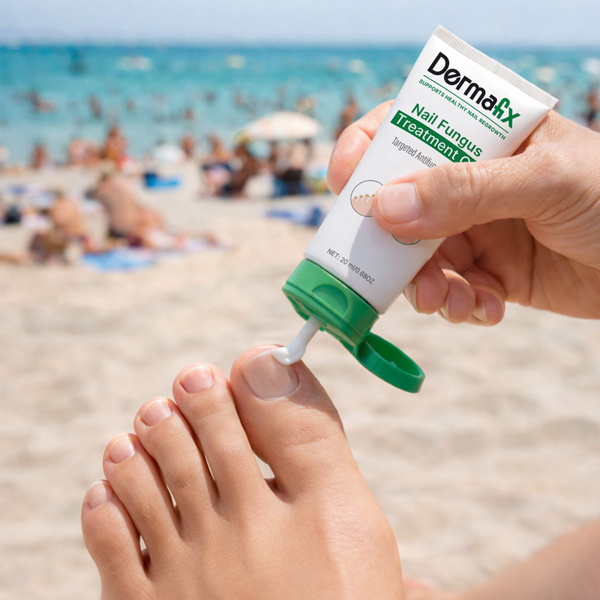
DermaFix includes tea tree oil within an oil-based formula that also contains Emu Oil and Squalane as delivery carriers. This formulation approach directly addresses the penetration limitation of standalone tea tree oil application, combining the antifungal properties of tea tree oil with the deep-delivery capability of the carrier system.

The formula also adds Colloidal Silver as a complementary antimicrobial agent, Bacillus Ferment for skin microbiome support, and Vitamin E and Olive Oil for nail bed nourishment, making it a more comprehensive approach than tea tree oil alone.

⚠️

Transparency note: The concentration of tea tree oil within DermaFix is not publicly disclosed. This is a genuine limitation. Clinical research suggests 5–25% as an effective range, but without label disclosure, independent assessment of whether DermaFix meets this threshold is not possible.

View DermaFix Full Formula →

How to Use Tea Tree Oil for Nail Fungus (If Applying Alone)

If you want to try tea tree oil as a standalone home treatment before investing in a formulated product, here is the approach best supported by available research:

Step 1

Dilute to Safe Concentration

Use a 5–25% tea tree oil solution. To achieve this, mix 1 part pure tea tree oil with 3–19 parts carrier oil (jojoba, fractionated coconut). Do not apply undiluted oil directly to the nail daily.

Step 2

Apply to Clean, Dry Nails

Use a clean cotton bud or small brush to apply the diluted oil directly to the affected nail, covering the full surface and attempting to reach under the free edge. Apply after washing and thoroughly drying the nail.

Step 3

Massage and Allow to Absorb

Gently massage the oil into the nail and surrounding skin for 30 seconds. Leave to absorb and do not rinse. For best results, apply at a consistent time each day, ideally before bed.

Step 4

Commit to 3+ Months

Results from tea tree oil application follow nail growth timelines, not treatment start date. A minimum of 3 months daily use is required to assess whether any visible improvement is occurring.

Frequently Asked Questions

Tea tree oil demonstrates genuine antifungal activity in laboratory studies and some clinical research. It is most effective for early-stage or superficial infections when applied at adequate concentration (5-25%) in a penetrating carrier, consistently over several months. It is not equivalent to prescription antifungal medications for established deep nail bed infections.
Published clinical studies have used concentrations between 5% and 100%. A 5-25% diluted solution applied daily is the most commonly studied and practically recommended range. Applying 100% undiluted tea tree oil daily carries a risk of skin sensitisation.
Yes. Fractionated coconut oil is a reasonable carrier for tea tree oil and improves spreadability. It does not have the same deep-penetration profile as Emu Oil or Squalane, but it is a safe and practical option for home preparation of a diluted tea tree oil nail treatment.
Following the same biology as all nail treatments: skin improvements may appear in 2-4 weeks, but visible nail change follows nail growth. Expect 8-12+ weeks before meaningful assessment is possible, and 6-12 months for complete clearance of an established infection.
A 5-25% diluted tea tree oil solution is generally safe for daily nail application. Undiluted tea tree oil can cause contact dermatitis in some individuals with repeated exposure. If redness, itching, or skin irritation develops, reduce frequency or dilution strength.
DermaFix offers a more comprehensive formula: tea tree oil is combined with Colloidal Silver for dual antifungal action, and with Emu Oil and Squalane for improved sub-nail delivery. For those who have tried standalone tea tree oil without success, the delivery mechanism difference may be the relevant factor.

Tea Tree Oil With a Deep-Delivery System

DermaFix combines Tea Tree Oil with a purpose-built penetration carrier to reach the fungus where surface applications cannot. Backed by a 90-day guarantee.

See DermaFix Official Pricing →
Dr. Emily Rhodes
Dr. Emily Rhodes
Holistic Health Researcher & Wellness Educator

With over 15 years of experience studying natural health solutions, Dr. Rhodes specialises in evaluating naturally-derived topical and supplement formulas for real-world applicability and evidence-based merit.

Her role is educational, not promotional. Her opinions do not replace medical advice.

Medical Disclaimer

The information on this page is for educational purposes only and is not intended to diagnose, treat, cure, or prevent any disease. Always consult a qualified healthcare professional before starting any new treatment. Individual results vary.

DermaFix is a topical cosmetic gel and is not evaluated or approved by the FDA for treatment of any medical condition.

Affiliate Disclosure: This page contains affiliate links. We may earn a commission if you purchase through our links, at no extra cost to you.